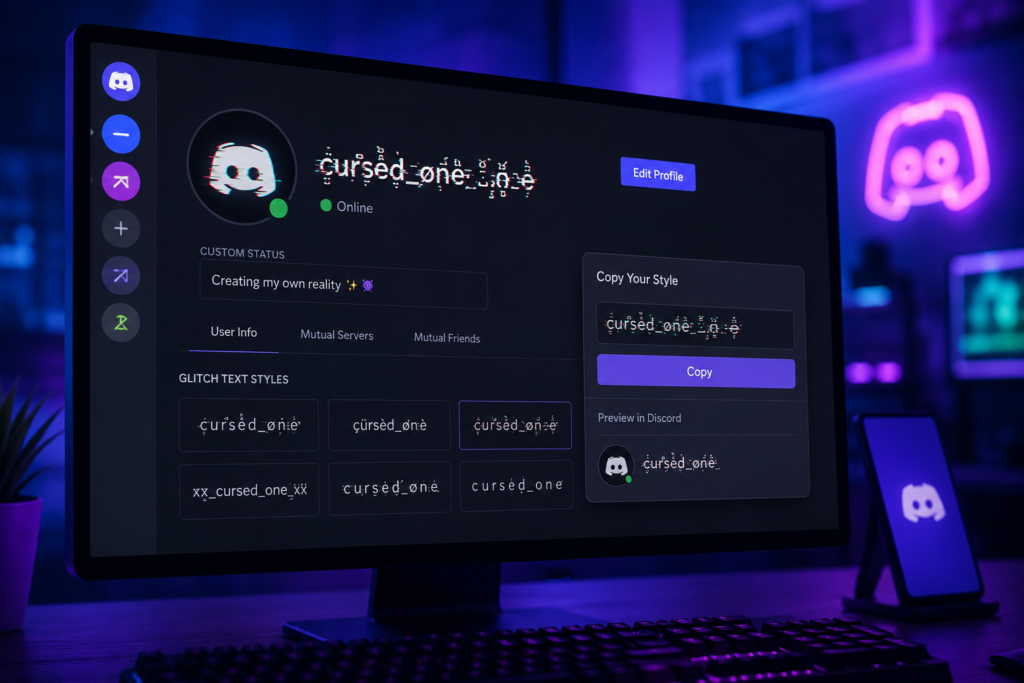
If you want a glitched Discord name, here’s the short version: pick a base word, run it through a Unicode combining-mark generator (or stack the marks yourself), keep the distortion light enough to stay legible, and paste it into your Discord display name. Yes, Discord supports these characters, they’re standard Unicode, not a hack or a special font, and they render the same on iPhone, Android, and desktop. What most guides skip is why it works and where it breaks, which is exactly what trips people up five minutes in.
A “cursed username” is built from combining diacritical marks, the same Unicode block that puts accents on letters like é or ñ, except instead of one mark, you’re stacking dozens onto a single character. The letter itself never changes. The decoration around it does. Push that stacking far enough and you get the dripping, corrupted look people call glitch text, Zalgo text, or cursed text, depending on intensity.
What Unicode Glitch Text Actually Is
Every character your keyboard produces lives at a specific address in the Unicode standard, a universal map every device on Earth agrees to render the same way. One block in that map, combining diacritical marks, runs from code point U+0300 through U+036F. These 112 characters were designed for ordinary accent work, turning an “e” into an “è.”
Unicode never capped how many marks you can attach to one letter. One mark gives you an accent. Forty marks stack on top of each other, spill above the letter, spill below it, and crowd the sides until the base character looks buried. Nothing is broken or hacked, you’re using standardized characters in a way the spec never anticipated.
Because every glyph is real Unicode, it copies and pastes identically everywhere: Discord, text messages, Reddit, a Notes app. Rendering can shift slightly between font engines, but the underlying characters never change. For the full character map, the Zalgo Unicode breakdown covers the block in detail.
Does Discord Actually Support These Characters?
Yes, with caveats that depend on which field you’re editing. Discord runs on UTF-8, the encoding behind most of the modern internet, and combining marks are valid UTF-8. The platform doesn’t block or flag them; they’re just text.
What changes is validation per field:
- Display name, loose validation, high tolerance for stacked marks. This is where most glitched names live.
- Username/@handle, tighter validation; heavy stacking often gets rejected during setup or a handle change.
- Bio, status, server names, channel names, chat messages, generally permissive, though channel names enforce stricter formatting behind the scenes.
So the honest answer is: Discord supports the characters everywhere, but enforces length and formatting unevenly across fields. Know your target field before you generate anything.
How to Create a Glitched Username: Step by Step
Method 1: Use a generator (fastest).
- Open a cursed text generator in any browser.
- Type your base word.
- Choose intensity, light glitch, medium distortion, or full Zalgo/void chaos.
- Copy the live output.
- In Discord, go to User Settings → My Account → Edit Profile, and paste into Display Name.
- Save, then check how it renders in the sidebar before committing further.
Method 2: Build it manually. Every letter can carry three categories of marks: above-marks that stack upward, below-marks that stack under the baseline, and overlay marks that sit directly on the letter’s body. You type the base letter, then immediately follow it with one or more combining marks, no space. The engine reads each mark as “attach to the previous character” and stacks them in typed order. This works, but it’s slow, there’s no preview until you actually render the string, and getting even distortion across a whole username by hand takes real trial and error. That’s the exact gap a glitch text generator closes for anything longer than a couple of letters.
Method 3: Layer symbol fonts. Swap base letters for visually similar characters from other Unicode blocks, math alphanumeric symbols, enclosed letters, small-caps, then add a light dusting of combining marks on top. This produces a “weird Unicode” look: stranger but often more readable than heavy Zalgo stacking, since the base shapes stay clean.
Cursed Username Ideas by Vibe
Generic word-plus-symbols rarely land. Names that get noticed pair a concept with the distortion.
Horror/liminal: the fourth wall, staticchild, nolightgetsout, forgottenfloor, wrongnumber.exe
Digital decay: corruptedstate, nullreference, segfaultsoul, 404 notfound, deprecated
Quiet unsettling (good at low intensity): stillwatching, almosthuman, wrongtimeline, skippedframe, echoofme
Run any of these through your generator at a low-to-medium setting first. Names built around a concept read as intentional even at subtle distortion; a normal word buried under maximum symbol stacking just reads as noise.
Unicode Combining Characters: What Most People Get Wrong
Order matters. Rendering engines process marks in the sequence they appear after the base character. The same five marks in a different order can render with gaps or overlapping artifacts because they’re competing for the same vertical space.
There’s a practical density ceiling. You can technically attach hundreds of marks to one character. Practically, most rendering engines, including Discord’s client, start compressing or truncating dense stacks, especially in fixed-height fields like the member sidebar. A name that looks gorgeous in a generator’s preview can collapse into a blob once Discord tries to fit it into a 16-pixel row.
Marks count toward character limits even though they’re nearly invisible on their own. Discord’s display name limit is measured in characters, and each combining mark is its own character. A five-letter word with ten marks per letter is a 55-character string, not a 5-character one, which is how people hit Discord’s cap far sooner than expected.
Readability: Cursed vs. Unreadable
This is the most important judgment call in the whole process. A glitched name works when someone can still read the base word at a glance while clearly registering that something is off. It fails when someone has to squint or give up, at which point it stops being style and starts being an obstacle to anyone trying to mention or find you.
Three rules keep it on the right side of that line:
- Keep stacking under roughly 8–10 marks per letter for anything meant to be read regularly. Save heavier stacking for fields people read once, like a bio.
- Don’t stack every letter. A word distorted on every third or fourth letter reads faster than one buried evenly, because your eye gets clean anchor points.
- Preview at actual Discord scale before committing. A generator’s preview box is usually bigger than Discord’s sidebar text.
Discord’s Limitations You Need to Know
up to 32 characters. Marks count individually, so heavy stacking eats this budget fast. the @handle normalizes harder than display names and commonly strips characters display names accept, if your handle reverts after saving, this is almost always why. Discord has no client-side “cursed text” toggle. Every glitched name was pasted in as raw Unicode. individual servers can block, flag, or auto-rename non-standard Unicode regardless of what Discord allows globally.
Moderation Guidelines: What’s Actually Allowed
Cursed text isn’t a Terms of Service violation on its own. The characters are standard Unicode, the technique involves no client modification or exploit, and it doesn’t put your account at inherent risk. Three real issues do come up:
Automod and bot filters. Many servers run bots that flag unusual Unicode density as a spam or filter-evasion signal, since heavy stacking has historically been used to dodge word filters. A flagged name reflects that server’s bot settings, not a platform-wide rule.
Accessibility impact. Screen readers can struggle with heavily stacked marks, sometimes reading individual diacritic names instead of the word. Moderate distortion is meaningfully more inclusive than maximum density.
Server owner discretion. Owners can set naming standards stricter than Discord’s own, common in professional or younger-audience servers. Check a server’s rules channel before assuming any intensity is fair game everywhere.
Common Mistakes to Avoid
The @handle tolerates the least heavy stacking. Estimate base word plus marks before you’re caught off guard. Beyond the uniqueness issue, Unicode from inconsistent sources sometimes renders unevenly elsewhere. Rendering engines differ slightly between Discord’s mobile and desktop clients. A horror-server name reads as try-hard in a study group, and a barely-distorted name disappears in a server full of maximum Zalgo. Read the cursed chat culture before committing.
The Bottom Line
A glitched Discord name comes down to one trade-off: visual chaos versus readability. The Unicode mechanics are simple once you see them, base letter, stacked combining marks, nothing actually altered underneath. What separates a name people remember from one they scroll past is restraint: matching intensity to the field, the server, and the version of you that you actually want people to recognize at a glance.
Generate a few options, preview them at real Discord scale, and pick the one that still looks like you under the distortion, not just noise wearing your name.
Frequently Asked Questions
Is a cursed Discord username against the rules?
No. It relies entirely on standard Unicode, not modified clients or exploits, nothing Discord’s Terms of Service prohibits.
Why does my glitched name look different on a friend’s phone?
Different devices use different font rendering engines for combining marks, which vary slightly in spacing and layering. The characters sent are identical; only the rendering shifts.
Can I use a fully glitched name as my @handle, or only as a display name?
Light to moderate stacking sometimes passes username validation; heavy stacking is commonly rejected. Display names tolerate far more intensity reliably.
Will a glitched username get me banned?
Not for the characters themselves. You can still be moderated for what the underlying word says, distortion doesn’t hide intent from a human reviewing a report, even if it occasionally slips past an automated filter.
What’s the difference between glitch text and Zalgo for a username?
Glitch text is lighter stacking meant to stay legible at a glance, better for a name people read regularly. A Zalgo text generator pushes the same technique to maximum density, prioritizing chaos over readability, and tends to work better in a bio or a one-off message.
Do I need an app to make cursed text on my phone?
No. Combining marks are standard text, so any browser-based void text generator or similar tool works without installing anything.
Pingback: Discord-Bios zum Kopieren: Cursed & ästhetische Vorlagen
Pingback: Bio Discord da copiare: modelli cursed ed estetici
Pingback: Bios Discord à copier-coller : modèles cursed et aesthetic
Pingback: Bios para Discord: 77 modelos para copiar e colar
Pingback: Discord-bio’s kopiëren: 77 cursed en aesthetic voorbeelden
Pingback: Bio na Discorda do skopiowania: 77 pomysłów i wzorów
Pingback: Discord Biyografileri Kopyala Yapıştır: 77 Hazır Örnek
Pingback: Bio Discord Salin Tempel: 77 Contoh Cursed dan Aesthetic
Pingback: Minecraft-Cursed-Namen: 109 Ideen und Glitch-Generator
Pingback: Nomi cursed Minecraft: 109 idee e generatore glitch
Pingback: Nomes cursed Minecraft: 109 ideias e gerador glitch
Pingback: Nombres cursed Minecraft: 109 ideas y generador glitch
Pingback: Minecraft-cursed-namen: 109 ideeën en glitch-generator
Pingback: Nicki cursed do Minecraft: 109 pomysłów i generator glitch
Pingback: Minecraft Cursed İsimleri: 109 Fikir ve Glitch Aracı
Pingback: Username Cursed Minecraft: 109 Ide dan Generator Glitch