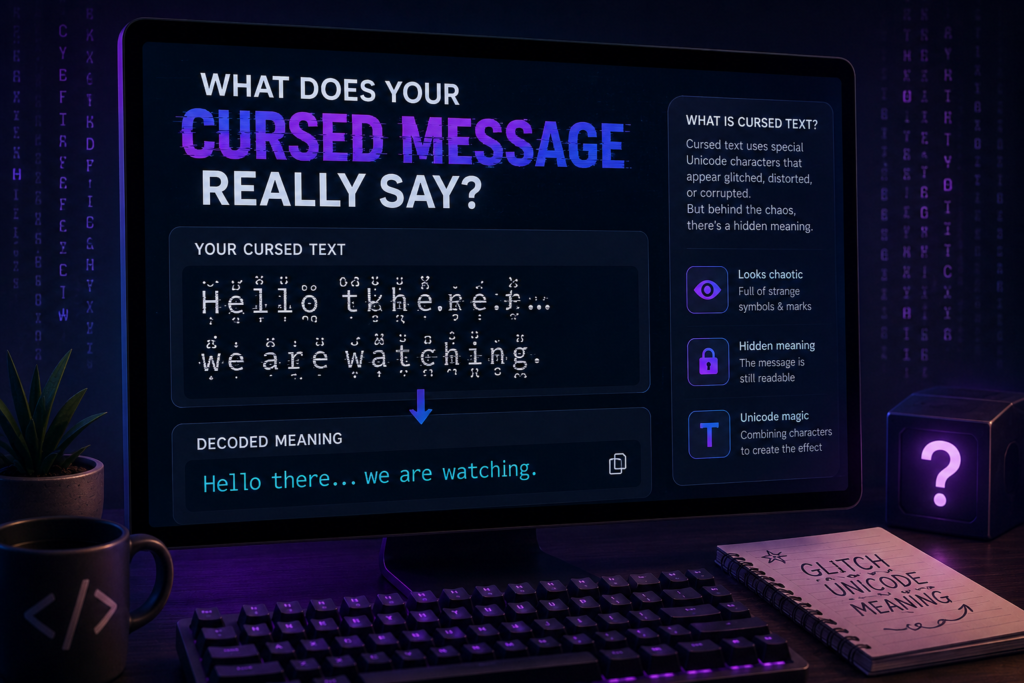
Cursed text doesn’t mean anything is actually cursed. At its core, it’s a signal, a way of saying “something here is off” without using a single extra word. The jagged marks, the melting letters, the symbols that don’t quite belong: they do the talking that punctuation and tone of voice usually handle in person. When someone sends you cursed text, they’re rarely warning you about a hex. They’re telling you to feel unease, humor, distance, or drama, depending on where you saw it and who sent it.
That’s the part most explainers skip. They’ll show you how to generate the effect, but not what it’s actually communicating once it lands in someone’s inbox, group chat, or comment section. This is the meaning layer, what cursed text signals in different corners of the internet, and how to read it when it shows up in your own messages.
The Short Answer: What Cursed Text Actually Communicates
Cursed text is built from stacked Unicode combining marks layered onto normal letters, which is why it looks corrupted, glitched, or “wrong” even though every character is standard and valid. That visual wrongness is the entire message. It borrows the feeling of broken data, ritual writing, or possessed text, the aesthetic of horror movies and creepypasta, and repurposes it as a tone marker.
In practice, cursed text tends to carry one of four meanings, depending on context:
- A joke at the reader’s expense, “this is absurd and I want you to notice”
- A mood or aesthetic signal, “I’m leaning into chaos, horror, or internet weirdness on purpose”
- A boundary or warning marker, “don’t take the next line literally” or “back off”
- A badge of belonging, “I know the reference, I’m part of this community”
None of these require the reader to believe anything supernatural. The “curse” framing is inherited from where the style became popular, 2004-era creepypasta forums, not from any actual belief that the text carries power. Understanding which of these four lanes a message falls into is the fastest way to correctly read what someone meant by sending it.
Why the Meaning Changes Depending on Where You See It
This is the piece that actually matters, because identical-looking text means different things in a Discord server than it does in a text message from a friend.
In Gaming and Discord
Inside gaming communities, cursed text usually isn’t about horror at all, it’s about identity and humor. A glitched username in Discord or a corrupted-looking clan tag signals “I’m technically fluent, and I don’t take this too seriously.” It’s closer to a costume than a warning. Players use it to stand out in a lobby list dominated by plain names, and heavier distortion often reads as a flex: proof someone knows how to layer combining marks without breaking the platform’s character limits. Because gaming spaces reward in-group signaling, the amount of distortion someone uses often maps to how deep they are in that particular server’s culture, a light touch reads as casual, while maximum chaos reads as a veteran move.
On Social Media (TikTok, Instagram, X)
On social platforms, cursed text shifts toward aesthetic branding. A bio wrapped in gothic or glitch characters is rarely trying to unsettle anyone, it’s trying to visually separate one profile from a feed full of identical sans-serif text. Here the meaning is closer to font choice on a poster: it says “this account has a mood,” whether that mood is horror-adjacent, gothic, or just deliberately strange. The intensity usually tracks with how central that aesthetic is to the account’s whole identity, a horror-fiction creator pushing heavy distortion is making a genre statement, while a lifestyle account using one glitched word in a caption is just borrowing the vibe for a single post.
In Memes and Internet Humor
Memes flipped cursed text’s meaning again. Here it usually signals irony or self-aware absurdity, the “this shouldn’t exist but it does” energy behind so much meme culture. A perfectly mundane sentence rendered in heavy Zalgo isn’t trying to scare anyone; it’s making fun of the idea of horror text by applying it to something trivial, like a grocery list or a Tuesday. That mismatch between form and content is the joke. Reading cursed text in a meme as a genuine threat misses the point entirely, it’s closer to sarcasm than sincerity.
In Horror Content and Creepypasta
This is the one context where cursed text gets closest to its literal roots. In horror fiction, ARGs, and creepypasta, the distortion is doing narrative work, usually representing a narrator losing control, a message being corrupted by whatever entity is haunting the story, or reality breaking down on the page itself. If you want a deeper breakdown of how to actually apply that pacing, light distortion building to a heavy payoff line, the scary text generator guide walks through matching font intensity to the message it’s carrying, which is the practical half of this same idea.
In Broader Internet Culture
Zoomed out, cursed text functions as a shared visual dialect, something an entire generation of internet users recognizes instantly without needing it explained. That recognition is itself part of the meaning. Seeing distorted text anywhere signals “this was made online, for people who are online,” almost regardless of the specific content underneath it. It’s less a font choice and more a cultural handshake.
How to Read a Cursed Message You Received
If someone sends you cursed text directly, three things usually tell you what they meant:
Who sent it. A friend sending glitched text in a group chat is almost always joking or being dramatic for effect. A stranger sending heavily distorted text unprompted is a different situation, and worth treating with more caution, the same way you’d treat any unsolicited strange message.
How heavy the distortion is. Light touches, a few marks, some stylized letters, read as casual and humorous. Text pushed to the edge of unreadable is either trying hard for a shock effect or, occasionally, testing whether a platform’s filters catch it. Heavier isn’t automatically more serious; it’s often just more committed to the bit.
What surrounds it. Cursed text sitting inside an obvious joke, meme, or gaming context carries the meaning of that context. The same string of characters dropped with no explanation into an otherwise normal conversation is more ambiguous, and it’s fair to just ask what someone meant by it, cursed text isn’t a code that requires decoding, it’s a style choice that occasionally needs a follow-up question.
Different Styles Send Slightly Different Signals
Not all cursed text reads the same way, and the style someone picks is itself part of the message:
| Style | What It Tends to Signal |
| Light glitch (few combining marks) | Casual, still readable, mild irony |
| Heavy Zalgo | Maximum shock or chaos, short-burst impact |
| Gothic/blackletter | Deliberate, aesthetic, “old world” seriousness rather than corruption |
| Small caps or substitution | Understated, “off” without looking broken |
Gothic text specifically tends to get misread as horror-only, when in practice it signals weight and tradition more than fear, the same style shows up in metal band logos, wedding invitations, and tabletop RPG character sheets. If you’re curious about why blackletter carries that “serious” tone instead of a scary one, the gothic text generator guide breaks down where the style actually comes from and why it reads differently than glitch or Zalgo text.
Common Cursed Phrases and What People Actually Mean by Them
A handful of phrases show up constantly in cursed text, and each one carries a fairly consistent intent once you’ve seen it enough times:
- “I can see you” / “you shouldn’t have opened this”, almost always a joke-scare, meant to get a reaction rather than genuinely unsettle. Context (a friend, a meme page) usually confirms this instantly.
- A single distorted word dropped into an otherwise normal sentence, typically emphasis, functioning the way italics or bold would in a text message, just with more visual weight.
- A username rendered in heavy distortion, usually a statement about the person’s online persona or community identity, not a message about the account owner personally.
- Cursed text replacing a caption entirely, with no words underneath, this is closest to pure aesthetic branding, where the visual is the whole point rather than a message layered under it.
The Bottom Line
Cursed text doesn’t have one fixed meaning, it has a small set of consistent signals that shift based on where you see it and who’s using it. In gaming, it’s identity. On social media, it’s aesthetic branding. In memes, it’s ironic. In horror content, it’s a narrative device. Across all of internet culture, it’s a shared visual language that says “this was made for people fluent in the internet,” before a single word is even read. Once you know which lane a message is in, decoding what someone actually meant by sending it stops being a mystery and starts being pretty obvious.
Frequently Asked Questions
Does cursed text actually mean something bad or evil?
No. The “cursed” label comes from early 2000s internet horror culture (most famously the Zalgo creepypasta), not from any real belief that the text carries meaning beyond its visual effect. It’s a style, not a spell.
Why do people use cursed text instead of just saying what they mean?
Because the visual distortion carries a tone that plain text can’t, the same reason people use italics, emoji, or ALL CAPS. It’s a faster way to signal mood than adding extra words.
Is there a difference between “cursed text” and “glitch text”?
In casual use, people treat them as interchangeable, but glitch text specifically refers to the combining-mark distortion technique, while “cursed text” is the broader umbrella that also covers gothic, symbol-substitution, and other unsettling-looking styles.
Should I be worried if someone sends me cursed text?
Almost never, context is what matters. A friend or group chat sending it is typically humor or drama for effect. Unsolicited cursed messages from strangers deserve the same caution you’d apply to any unexpected message, regardless of the font.
Does the meaning of cursed text change across platforms?
Yes. The same distorted phrase reads as an in-joke on Discord, an aesthetic choice on Instagram, irony in a meme, and a narrative device in horror fiction, the text itself doesn’t change, but the surrounding platform culture shapes how it’s meant to land.
Pingback: Cursed Text per Instagram – Font per bio e didascalie