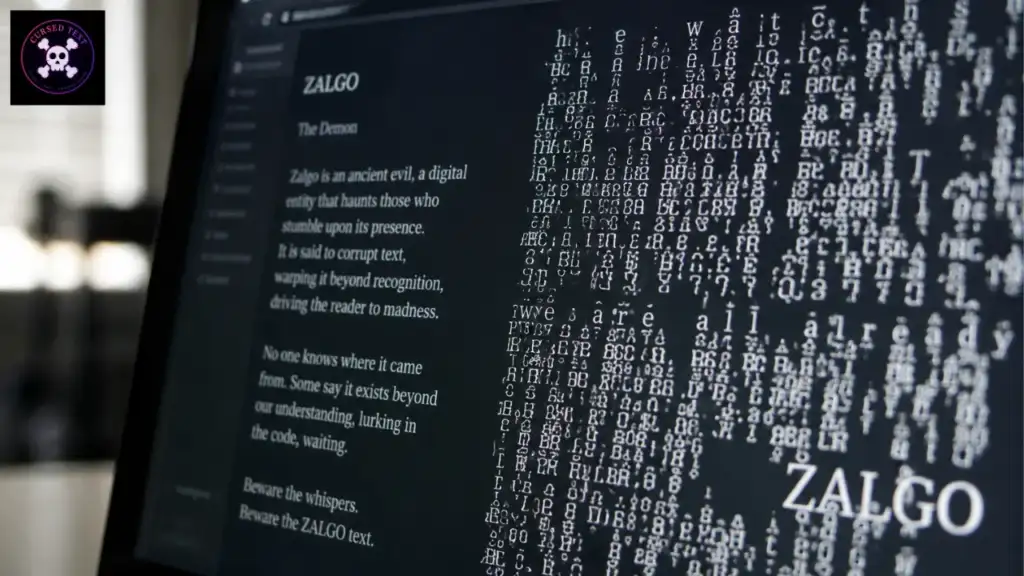
If you’ve ever seen text that looks like it’s actively falling apart, letters drowning in symbols, words that seem like they crawled out of a horror game, you’ve seen Zalgo text. But most people using it have no idea where it actually came from.
The story behind Zalgo is one of the most interesting pieces of internet history you’ve probably never heard in full. It starts with a webcomic, turns into one of the earliest viral horror memes the internet ever produced, and eventually becomes the reason an entire style of distorted Unicode text exists today.
This is the full story, and when you’re ready to generate your own, our free Zalgo text generator at Cursed Text Creater is ready instantly.
Who or What Is Zalgo?
Before there was Zalgo text, there was Zalgo the entity.
Zalgo started as an internet horror character, a nameless, formless presence associated with chaos, corruption, and the collapse of reality itself. It didn’t come from a book, a movie, or a video game. It emerged organically from internet culture in the mid-2000s, built piece by piece through forum posts, image edits, and collective storytelling.
The defining visual of Zalgo wasn’t a monster with a face. It was corruption itself. Wherever Zalgo appeared, things broke down. Images glitched. Text distorted. Normal familiar things became wrong in ways that were hard to describe but impossible to ignore. The horror wasn’t explicit, it was that feeling that something fundamental had gone wrong with reality and you couldn’t identify what.
That specific feeling, wrongness without a clear source, is exactly what Zalgo text captures. And it’s why the text style named after this character still resonates so deeply with people who encounter it for the first time.
The Origin: Where It All Started
The Zalgo character has roots in a specific moment: a 2004 webcomic called Ctrl+Alt+Del by Tim Buckley.
Ctrl+Alt+Del was one of the most popular webcomics at the time, a gaming-focused strip with a massive following across early internet forums. In one particular strip, a robot character named Zeke was shown with altered eyes and distorted speech, briefly depicted as corrupted or possessed.
Early internet horror communities, particularly on Something Awful and 4chan’s /x/ board, the paranormal discussion board that became a primary breeding ground for internet horror culture, took this image and ran with it. The corrupted aesthetic resonated immediately with people experimenting with glitch imagery.
From there, Zalgo became a community project. Users started editing webcomics and images, replacing normal characters with corrupted glitched versions, pupils going wrong, things bleeding into each other, text beneath the images becoming distorted.
The name Zalgo came from the corrupted text itself. In early edits, captions beneath distorted images read “HE COMES”, and in the broken stacked Unicode text that accompanied these images, Zalgo was the name given to whatever was coming. The entity and the text style were born simultaneously, from the same community, in the same moment.
How Zalgo Spread Through Early Internet Culture
Understanding why Zalgo exploded requires understanding what the internet looked like in 2004 and 2005.
Reddit was one year old. Twitter didn’t exist yet. The places where internet culture actually lived were forums, Something Awful, 4chan, YTMND, early DeviantArt. These were tight communities with their own languages, inside jokes, and creative traditions.
Creepypasta, short horror stories designed to be copy-pasted and shared, was becoming a recognized format. The Slender Man would come a few years later. SCP Foundation launched in 2008. But in 2004 and 2005, Zalgo was one of the first viral internet horror phenomena to spread genuinely fast across multiple communities simultaneously.
The formula worked because it was participatory. Anyone could take a webcomic, edit it, add the corrupted Zalgo aesthetic, and post it back to the community. The more people contributed, the more the character felt like something real, something that existed in the internet’s collective imagination even though no single person created it. It wasn’t a story someone wrote. It was a vibe that hundreds of people built together.
How Zalgo Text Was Actually Created
Here’s where the internet horror story and the text style fully converge.
The distorted corrupted text beneath early Zalgo images wasn’t made by a programmer with specialized tools. It was created using a simple trick anyone with a text editor could reproduce, stacking Unicode combining characters.
Unicode is the international standard that defines every character used on every device on earth. Within Unicode there’s a specific block called combining diacritical marks, characters originally designed to add accents and language marks to base letters. The umlaut in German, the tilde in Spanish, the accent in French, all combining marks that attach to the letter before them.
The key detail: Unicode places no hard limit on how many combining marks can attach to a single character. For normal language use you’d never stack more than two or three. But stack twenty, thirty, fifty of them above and below a single letter and something completely different happens. The character visually overflows its normal boundaries. Symbols pile up in every direction, bleeding into surrounding lines. The text looks broken, corrupted, and wrong in exactly the way the Zalgo aesthetic demanded.
Early internet users discovered this trick and realized it was the perfect visual language for Zalgo content. The text literally looked like something had gone wrong with it, like reality itself was breaking down character by character.
Within a few years “Zalgo text” had become a recognized term across internet communities. The creepypasta character and the text style became permanently linked, one name for two related things that were born together.
For a deeper look at the specific Unicode combining characters that create this effect, our complete list of cursed Unicode symbols breaks down exactly which marks do what and how they work together.
Zalgo vs. Cursed Text vs. Void Text: What’s the Difference?
By the time Zalgo text had been around a few years, different communities started using different names for it. Here’s a clear breakdown:
Zalgo text is the original name, the distorted Unicode combining mark style named directly after the internet horror character. Most technically accurate term.
Cursed text became the broader casual term as the style spread beyond horror communities. When TikTok users, Discord gamers, and Instagram accounts started using distorted Unicode for aesthetic reasons, “cursed text” became the catchall name for the whole category.
Void text emerged from gaming and dark aesthetic communities as an alternative name for the same heavy Zalgo style. Technically identical, same Unicode combining characters, same visual output, different name. Our void text generator guide covers this style fully.
Glitch text is the lighter end of the spectrum, moderate combining mark stacking that creates a corrupted digital look without full Zalgo chaos. Most commonly used for gaming usernames and social media bios.
All of them trace back to the same source. The names changed as the style traveled across different corners of the internet. The underlying technology never did. Our complete guide to cursed text, glitch and Zalgo Unicode breaks down every style in full detail.
Where Zalgo Lives in 2026
Twenty years after Zalgo first appeared on Something Awful and 4chan’s /x/ board, the character and the text style are still very much part of internet culture today.
Discord horror servers are the direct descendants of those early forum communities. SCP Foundation roleplay servers, analog horror communities, ARG groups, and creepypasta channels all use Zalgo text as part of their visual identity. Our Zalgo text for Discord guide covers exactly what works on the platform.
Analog horror on YouTube and TikTok, one of the fastest-growing horror content formats right now, relies heavily on the corrupted text aesthetic Zalgo pioneered. Projects like Local58 and Mandela Catalogue use distorted text as a core visual element.
Creepypasta communities on Reddit and Tumblr still use Zalgo text in story formatting. The original “HE COMES” phrasing still appears, a direct callback to 2004.
Gaming communities on Discord, Roblox, Steam, and competitive platforms have adopted Zalgo and glitch text for usernames and branding. Most found the aesthetic through current social media rather than 2004 forums, but they’re participating in the same tradition. Our Roblox glitch text guide covers that platform specifically.
Generate Zalgo Text Right Now
The same distorted Unicode text that defined internet horror culture in 2004 is available to anyone today in seconds, no technical knowledge required.
Cursed Text Creater generates Zalgo text, glitch text, void text, and weird Unicode text instantly. Type anything into our free cursed text generator, pick your style and intensity, copy the output, and paste it into Discord, TikTok, Instagram, iMessage, Roblox, or any platform that accepts text.
Want ready-made phrases without generating anything? Our cursed text copy paste list has over 200 ready strings organized by platform and vibe.
The Text That Started It All
Most internet trends have a clear origin, a product launch, a celebrity post, a single viral moment. Zalgo isn’t like that. It grew out of a community, spread through participation, and embedded itself into internet culture so thoroughly that twenty years later it’s still everywhere, Discord servers, TikTok bios, horror content, gaming usernames, and group chats.
Every letter dripping with symbols carries that entire history inside it. A tiny piece of internet folklore that started in a forum thread in 2004 and never really stopped spreading.
Use our free Zalgo text generator at Cursed Text Creater, Zalgo text, void text, glitch text, and weird Unicode instantly. Free, unlimited, no sign-up. The whole twenty-year tradition, copy and paste ready in seconds.
Frequently Asked Questions
What is Zalgo?
Zalgo is an internet horror character from 2004, born in communities like Something Awful and 4chan’s /x/ board. The name is permanently linked to the distorted Unicode text style used in early Zalgo horror content, today “Zalgo text” means that heavily stacked combining mark distortion seen across Discord, TikTok, and gaming platforms.
Is Zalgo text the same as void text?
Yes, technically identical. Both use the same Unicode combining diacritical marks at heavy intensity. “Void text” became a popular alternative name in gaming communities. Same output, different name.
Is Zalgo a real creepypasta?
Zalgo predates the formal creepypasta genre by several years. It emerged from community participation rather than a single authored story, which makes it one of the most unique and influential pieces of early internet horror culture.
Who created Zalgo?
No single person. Zalgo emerged from collective participation across internet communities in 2004 and 2005, a genuine community creation built by hundreds of contributors across multiple platforms.
How old is Zalgo?
Zalgo is approximately 20 to 21 years old as of 2026. The character first appeared in 2004 on internet forums including Something Awful and 4chan’s /x/ board, making it one of the oldest surviving internet horror phenomena still actively used today across Discord, TikTok, gaming communities, and horror content creation.
Is Zalgo a Creepypasta?
Zalgo predates the formal creepypasta genre but is closely associated with it. The character emerged in 2004, before “creepypasta” became an established term. Unlike Slender Man or Jeff the Killer which were single authored stories, Zalgo grew from collective community participation across forums. Most internet horror communities today categorize Zalgo as a creepypasta by cultural convention, even though it technically came first and helped establish the entire genre.