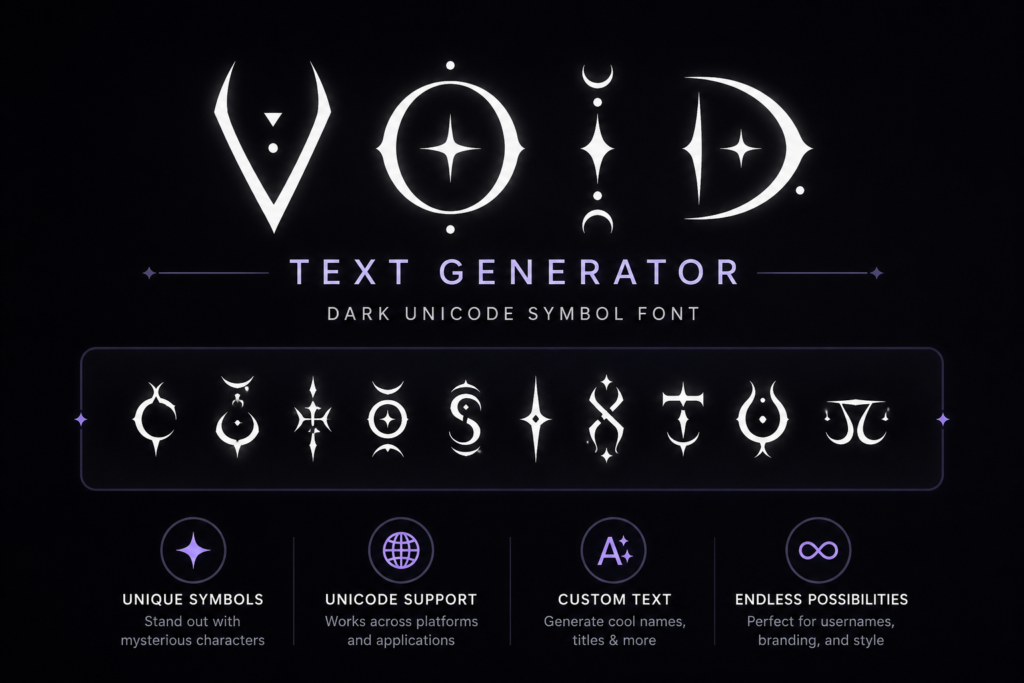
Void Text Generator — Dark Unicode Symbol Font

void text generator dark unicode font

There is a specific kind of text that does not look like it belongs in this world. Not just creepy — actually wrong. Letters swallowed by stacked symbols. Characters that appear to be dissolving into negative space. Words that look like they were typed from the other side of a screen that no longer exists.

That is void text. And if you have never heard that term specifically, you have almost certainly seen it — in a Discord server that made you uneasy, in a TikTok bio that stopped your scroll cold, or in a Reddit comment that felt like it was written by something that should not have access to a keyboard.

This guide covers everything about void text and dark Unicode symbol fonts: what they actually are, how the Unicode engine behind them works, how void text differs from Zalgo and glitch text, and exactly how to generate it free using Cursed Text Creater — no downloads, no sign-ups, no technical knowledge required.

What Is Void Text?

Void text is a style of distorted Unicode text that creates the visual impression of emptiness, corruption, and darkness — letters partially or fully consumed by stacking symbols until the original characters seem to disappear. The name captures the aesthetic precisely: text that looks like it is being swallowed by nothing.

It belongs to the same family as Zalgo text, cursed text, and glitch text — all styles that manipulate Unicode combining diacritical marks to produce visually distorted output. The difference lies in the feeling each produces. Glitch text looks like a broken screen. Zalgo text reads as pure chaos. Void text reads as absence — dark, quiet, and fundamentally wrong in a way that is harder to place than outright horror.

In US internet communities, void text sees its heaviest use in dark aesthetic spaces, analog horror communities, SCP roleplay servers, gothic social media niches, and anywhere the visual language of digital emptiness matters more than shock value. It is a style built for atmosphere rather than noise.

The Unicode Engine Behind Void Text

Void text is not a font. It cannot be downloaded or installed in any design software. It is standard Unicode text — the same universal character standard used on every device and operating system on earth — used in ways that produce a visually extraordinary effect.

The Unicode standard defines every character used in human writing across all languages. Within that standard is a block called combining diacritical marks — characters in the range U+0300 through U+036F. These 112 characters were designed to add accent marks to base letters: the grave accent in French, the tilde in Spanish, the umlaut in German.

The critical detail: Unicode places no hard limit on how many combining marks can attach to a single base character. A void text generator exploits this by stacking fifteen, twenty, or fifty combining marks above and below each letter simultaneously — causing characters to visually overflow their normal line boundaries, bleeding upward and downward until the original letter is barely visible beneath the accumulated weight of symbols.

Beyond standard diacritics, void text generators pull from darker areas of the Unicode library: block characters, box-drawing elements, and symbols from Mathematical and Technical Unicode ranges (U+2300 through U+23FF, U+25A0 through U+25FF) that carry inherently cold, angular, and mechanical visual qualities. Layered with combining marks on standard Latin letters, these produce the specific “dark symbol font” quality that distinguishes void text from other cursed styles.

Because every character used is valid standard Unicode, void text copies and pastes correctly on every modern platform. The distortion is entirely visual — the underlying data is completely standard. For a full technical and historical breakdown of this technique, our guide to what cursed text is, including glitch, Zalgo, and weird Unicode, covers everything from origin to Unicode mechanics in detail.

Void Text vs. Zalgo Text vs. Glitch Text

These three terms circulate in the same US internet communities and get used interchangeably. They are related but each occupies a distinct aesthetic register.

Zalgo text is the original named style — created in reference to the 2004 internet horror character Zalgo, a formless entity associated with chaos and digital corruption. Zalgo uses maximum combining mark stacking in all directions, producing dense overflow that reads as overwhelming and chaotic. The effect is loud. For a deep background on Zalgo specifically, the Zalgo text generator guide covers the full history and all available styles.

Glitch text is a lighter, more controlled version. Combining mark stacking is moderate — enough to produce a digital-malfunction look while keeping the text mostly readable. The aesthetic language is tech-horror rather than supernatural chaos. This is the most versatile style for gaming usernames, Discord display names, and social media bios where readability still matters.

Void text occupies its own space. Where Zalgo is loud and chaotic, void text is dark and receding. The combining marks used emphasize downward and inward stacking rather than maximum vertical overflow — creating the impression of text being pulled away or consumed rather than exploding outward. Combined with dark Unicode symbol characters from technical and geometric ranges, the result feels like absence rather than chaos.

All three styles are generated with the same fundamental technique. What distinguishes them is character selection, directional stacking emphasis, and supplementary Unicode symbols. The cursed text generator free online tool covers how all three styles work in a single generator.

What “Dark Unicode Symbol Font” Actually Means

Standard Latin letters carry a visual warmth built up through centuries of typographic tradition. Swap those in for Unicode characters from Mathematical Alphanumeric Symbols, Miscellaneous Technical, or Geometric Shapes blocks — and the visual register shifts entirely. These symbols were designed for technical notation and geometric representation. They have no humanistic proportion and no familiar readability warmth. Applied to text alongside combining mark stacking, they produce what people call a “dark symbol font” effect.

This is not a font in the typographic sense. There is no typeface file, no weight variation, no kerning table. What exists is a consistent visual register achieved through Unicode character selection and combining mark application. The output looks like dark typography. It reads like a foreign writing system. It behaves exactly like standard text — copying, pasting, and rendering on every platform that accepts Unicode input.

This is the core reason void text is accessible to everyone. No design software, no creative tools, no technical knowledge required. The entire effect runs in a browser generator in real time.

Where US Users Are Using Void Text in 2026

Void text has specific communities and contexts across US platforms right now.

Discord is the most active void text environment. Dark aesthetic servers, SCP Foundation roleplay communities, analog horror production groups, gothic interest servers, and horror gaming clans all use void text as part of their visual identity. Every Discord text field — usernames, display names, bios, server names, channel names, and messages — supports full void text at any intensity with no restrictions.

TikTok dark aesthetic accounts — witchcore, analog horror, dark academia, gothic niches — use void text in display names and bios as permanent brand identity markers. The effect stops the scroll immediately in a feed built around visual thumbnails because void text looks wrong in a way that demands a second look before the eye moves on.

Reddit communities centered on creepypasta, SCP content, internet horror, and glitch aesthetics use void text in comments and post titles. The r/creepypasta, r/internethorror, and r/SCPDeclassified communities have established void text traditions that have been active for years.

Instagram bios support medium to heavy void text. Gothic and dark aesthetic accounts in the US use void text display names and bio lines to signal aesthetic identity instantly to anyone who lands on their profile.

Gaming platforms — Steam, Roblox (in bios and descriptions), and assorted PC and mobile game profile fields — support Unicode void text in display names and profile sections. A void text username in a PvP environment communicates something specific about how you want opponents to feel.

iMessage, WhatsApp, and Telegram all support full void text in messages, group chats, and status fields. Sending void text in a group chat with no warning produces a very specific reaction that plain text never achieves.

How to Generate Void Text Free — Step by Step

Using the void text generator at Cursed Text Creater takes under one minute on any device.

Step 1 — Open Cursed Text Creater in any browser. Safari, Chrome, Firefox, Edge — every browser on iPhone, Android, laptop, and desktop works identically. No account creation. No download.

Step 2 — Type your text into the input field. Your name, a username, a phrase, a caption — any text works as input.

Step 3 — Select the void or dark symbol style from the available options.

Step 4 — Adjust intensity. Lower intensity produces subtle dark corruption — still readable, unsettling in a quiet way. Higher intensity produces denser symbol stacking and a deeper visual darkness. The right setting depends on where you are using the output and how much readability you need.

Step 5 — Watch your output generate in real time. No submit button, no loading screen. Void text appears instantly and updates as you type.

Step 6 — Hit Copy and paste the output into Discord, TikTok, Instagram, iMessage, Reddit, Roblox, Steam, or anywhere that accepts text input.

The generator is completely free, has no usage limits, requires no account, and runs entirely in the browser. Nothing is stored or sent to any server.

Why Void Text Works as a Dark Aesthetic Tool

Void text persists in US internet culture for the same reason it emerged in the first place: it produces a specific visual effect that no other free, copy-paste-ready tool creates.

Most dark aesthetic tools require design software, paid subscriptions, or at minimum some creative knowledge. Void text requires none of these. You type your text, copy the output, and paste it anywhere. The visual effect — text that looks like it is disappearing into itself, consumed by symbols, too dark to fully exist — is achieved instantly with no learning curve.

The deeper reason it works comes down to how the human visual system processes the unexpected. Plain text is invisible to us — our eyes pass over it in search of meaning, processing words without registering the text itself. Void text breaks that invisibility. The distortion registers as a signal that something is different or wrong, forcing the eye to actually look at the text before reading through it. That moment of forced attention is the entire mechanism behind why void text stops scrolls, causes double-takes, and makes messages land differently than the same words in plain text.

For communities that communicate through aesthetic signals — dark gaming clans, gothic social media accounts, horror fiction communities, analog horror creators — void text is a foundational tool precisely because the effect is both visually powerful and practically effortless to produce.

Frequently Asked Questions

What is void text?

Void text is a style of distorted Unicode text that creates the visual impression of darkness and emptiness — letters partially consumed by stacked symbols from combining diacritical mark ranges and dark Unicode symbol blocks. It is related to Zalgo and glitch text but carries a quieter, more atmospheric quality rather than maximum chaos distortion.

Is void text the same as Zalgo text?

Related but distinct. Zalgo text is maximum-distortion, loud, and chaotic. Void text is darker and more receding — the impression of absence rather than chaos. Both use Unicode combining marks; the difference is in character selection, directional stacking emphasis, and the supplementary symbols applied. For the full Zalgo experience, the Zalgo text generator covers that style specifically.

Does void text work on Discord, Instagram, and TikTok?

Yes. Void text uses standard Unicode characters supported on every major platform. Discord, Instagram, TikTok, Twitter/X, Reddit, WhatsApp, iMessage, and most gaming platforms all render void text correctly. Copy the output and paste directly.

Is the void text generator free?

Completely free. No account, no usage limits, no premium tier. The generator runs in any browser on any device.

Why does void text look slightly different on different devices?

The Unicode characters are identical everywhere. What varies is how each device’s fonts and rendering engine display stacked combining marks. iOS, Android, and Windows handle Unicode diacritics slightly differently. The void text effect is present across all platforms — the precise visual depends on the rendering engine.

Can void text be used for creative or artistic work?

Absolutely. Beyond social media bios and gaming usernames, void text is used in digital art, glitch aesthetic design, horror fiction formatting, analog horror video production, and dark brand identity work. The cursed text generator free online tool and the complete guide to cursed, Zalgo, and glitch text cover more use cases across all of these areas.

Leave a Comment

Your email address will not be published. Required fields are marked *